AP Chemistry Mock Exam Review System: Your Complete Strategic Framework for Units 1-7
Stop treating mock exams like practice tests. Start treating them like diagnostic intelligence that reveals exactly where you'll lose points — while fixes are still free.
Mr. Hisham Mahmoud
1/2/20263 min read
AP Chemistry Mock Exam Review System: Your Complete Strategic Framework for Units 1-7
Stop treating mock exams like practice tests. Start treating them like diagnostic intelligence that reveals exactly where you’ll lose points — while fixes are still free.
Why Most Students Waste Their Mock Exams
Let me tell you about two students I worked with last year.
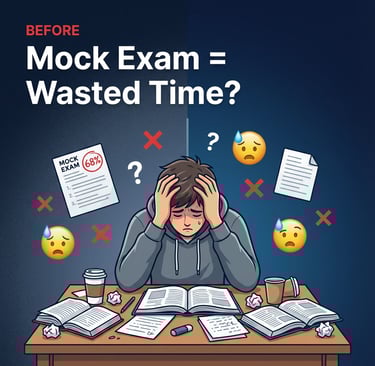
Student A took their AP Chemistry mock exam in January, scored 68%, felt discouraged, and moved on. They studied “everything” for the real exam in May and scored 71% — barely any improvement.
Student B took the same mock, scored 65%, then spent three hours systematically analyzing every mistake using a strategic framework. They identified exactly three units where concept gaps were costing them points. Ten days of targeted practice later, their real exam score? 87%.
Same starting point. Wildly different outcomes.
The difference wasn’t intelligence or study time. It was system.
Get the Complete Mock Exam Review System
I’ve created a comprehensive strategic framework that walks you through exactly how to:
✅ Prepare strategically for your mock (7-day pre-mock study plan for Units 1-7)
✅ Execute the mock properly to generate accurate diagnostic data
✅ Analyze mistakes systematically to identify root causes
✅ Create targeted improvement plans that fix gaps fast
This isn’t a content review guide — it’s a planning and system framework with:
3-phase strategic approach
Unit-specific review strategies
Mistake categorization framework
Checklists and planning worksheets
Timeline and implementation roadmap
Download the Complete Mock Exam Review System (Free) →
What Makes This System Different
This is NOT:
❌ Generic study tips
❌ Content you need to memorize
❌ Just another practice test
This IS:
✅ A strategic framework for extracting maximum learning from mocks
✅ A systematic approach to identifying weaknesses with surgical precision
✅ A planning system showing exactly what to do before, during, and after your mock
The 3-Phase System Overview
Phase 1: Pre-Mock Strategic Preparation (7-10 days before)
Goal: Enter the mock with a solid foundation so results accurately reflect your true understanding.
Key strategies:
7-day unit-by-unit review plan (not re-learning, reactivating)
High-yield concept identification for each unit
Pattern recognition practice over content cramming
Confidence documentation training
Time investment: 45-120 minutes per day depending on unit
Phase 2: Mock Exam Execution (Test day)
Goal: Generate accurate diagnostic data through proper simulation.
Critical requirements:
Real timing (no pausing)
Real resources only (formula sheet + calculator)
Real environment (quiet, focused, exam conditions)
Confidence marking on every question (✓/~/?)
Why simulation matters: If you cheat the conditions, you only cheat yourself out of accurate diagnostic information.
Phase 3: Post-Mock Analysis & Improvement (After + next 7-10 days)
Goal: Transform mistakes into targeted improvement plan.
The systematic approach:
Step 1: Self-mark thoroughly (60-90 min)
Use detailed rubrics, not just answer keys
Calculate scores by unit, not just overall
Understand WHY wrong answers are wrong
Step 2: Categorize every mistake
Every error falls into one category:
Content Gap: Don’t understand concept → Need re-learning
Careless Error: Knew it but made silly mistake → Need checking protocols
Exam Technique: Misread question or wrong format → Need rubric practice
Time Pressure: Ran out of time → Need pacing practice
Application Gap: Can’t apply to novel scenarios → Need varied practice
Step 3: Create data-driven improvement plan
Identify high/medium/low priority units based on mistake frequency and type, then create specific intervention plans with deadlines.
What You’ll Find in the Complete System
The downloadable framework includes:
📋 Pre-Mock Preparation:
7-day study plan with time allocations
Unit-specific high-yield focus areas
Preparation checklists
Confidence assessment training
📋 Execution Strategy:
Simulation requirements checklist
During-exam protocols
Time management frameworks
Confidence documentation guide
📋 Post-Mock Analysis:
Systematic marking approach
Mistake categorization framework
Analysis worksheets for every error
Priority-setting rubrics
Intervention action plan templates
📋 Unit-Specific Strategies:
Review approaches for Units 1-7
Common mistake warnings
Best practice methods for each unit
High-yield concept identification
📋 Success Metrics:
How to measure improvement
Quantitative and qualitative indicators
Mastery verification methods
Get Your Complete Mock Exam Review System Here →
Why This Approach Works
Traditional approach: Take mock → Look at score → Feel bad or good → Move on
This system: Take mock → Categorize mistakes → Identify patterns → Target weaknesses → Verify mastery → Improve dramatically
The students who improve most between mock and real exam aren’t the ones who scored highest initially. They’re the ones who used the mock as a diagnostic tool and systematically fixed what it revealed.
Common Implementation Mistakes to Avoid
❌ Skipping Phase 1: Taking the mock “cold” generates data about memory gaps, not understanding gaps
❌ Poor simulation: Taking it with notes open or pausing doesn’t reflect real exam performance
❌ Focusing only on overall score: Doesn’t reveal specific unit weaknesses
❌ Rushing Phase 3: Spending 3 hours on the mock but only 20 minutes analyzing wastes the opportunity
❌ No specific deadlines: “I’ll work on weak units when I have time” means never
✅ The fix: Follow the system completely. One mock + thorough analysis beats five mocks with no intervention.
Your Implementation Roadmap
TODAY:
Download the complete system
Schedule your mock exam date
Block out Phase 1 preparation time
7-10 Days Before:
Execute Phase 1 preparation plan
Focus on pattern recognition and speed
Mock Day:
Full simulation with confidence marking
Take a break after (don’t look up answers immediately)
Within 48 Hours After:
Complete Phase 3 analysis (2-3 hours)
Create improvement plan with deadlines
Next 7-10 Days:
Execute targeted interventions
Re-test weak areas
Verify mastery
Download Your Complete System
Stop guessing what to study. Let your mock exam tell you exactly where to focus.
Get the Complete Mock Exam Review System (Free) →
The framework is a complete HTML file you can open in any browser, print sections as needed, or save as PDF. It includes all planning templates, checklists, and strategic guidance for Units 1-7.
From “I Don’t Get It” to “I Ace It”
apchemistryrescue.com
Questions about implementing this for your specific timeline? Drop a comment below.