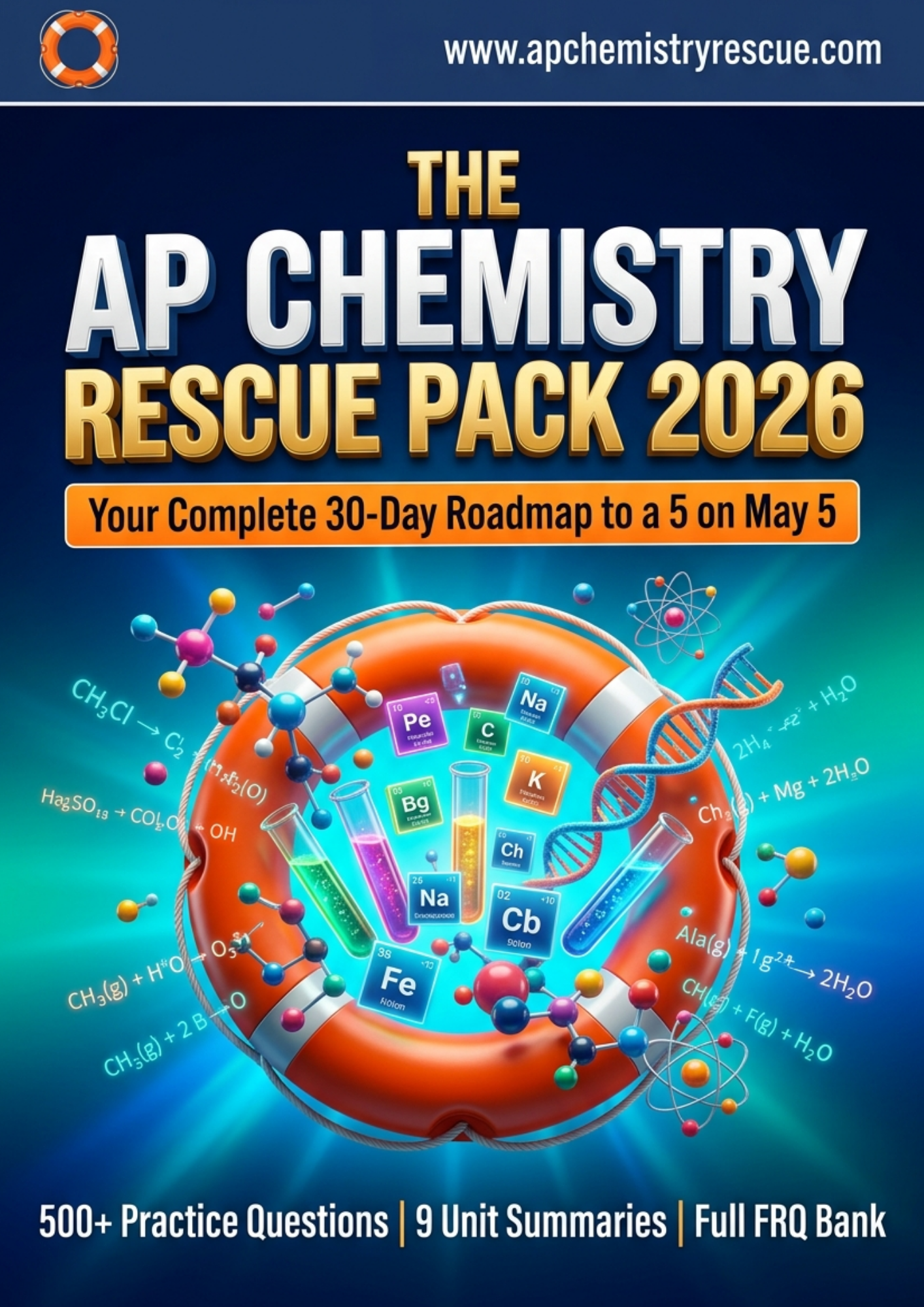
THE AP CHEMISTRY RESCUE PACK 2026 -
30-Day Roadmap to a 5 on May 5
$39.00
Stop Panicking. Start Preparing. Score Your 5.
You already know what happens without a plan. You open your textbook. You stare at Unit 4. You flip back to Unit 2 because you forgot half of it. You spend three hours "studying" and still feel like you know nothing.
The AP Chemistry exam is 60 multiple-choice questions, 7 free-response questions, 3 hours and 15 minutes — and it covers nine full units of chemistry that have been meticulously designed to expose every gap in your understanding.
That is exactly why this pack exists.
What Is The AP Chemistry Rescue Pack 2026?
The AP Chemistry Rescue Pack 2026 is not a textbook. It is not a collection of random notes. It is a complete, structured, exam-focused revision system built specifically for one purpose: getting you from where you are right now to a 5 on May 5, 2026.
Every page, every question, every cheat sheet inside this pack was created by Mr. Hisham Mahmoud, a chemistry teacher with years of experience watching students succeed and fail — and knowing precisely what makes the difference between the two.
This is that difference. In one pack. Available right now.
📦 WHAT'S INSIDE THE RESCUE PACK
🗓️ Part 1: The 30-Day Master Roadmap
The 30-Day Revision Guide is the backbone of the entire pack. It takes the nine AP Chemistry units and breaks them into a day-by-day schedule that leaves nothing to chance.
✅ Daily Focus: Each day has a clear unit focus, specific topic, and target page
✅ Checkpoint Reviews: Built-in review days (Days 10, 20, 30) to lock in knowledge
✅ MCQ Practice Sets: Timed practice aligned with each checkpoint
✅ No Guesswork: You know exactly what to study, when to study it, and how to test yourself
Visual Roadmap Included: Color-coded calendar showing your complete journey from Day 1 (PES & Electron Configuration) through Day 30 (Final Review & Rest).
If you start this guide today and follow it every day, you will have covered the entire AP Chemistry curriculum at least once before the exam. Not skimmed it. Covered it.
📚 Part 2: Unit-by-Unit Summary PDFs — All 9 Units, Zero Fluff
Each of the nine AP Chemistry units comes with its own dedicated summary PDF. These are not fifty-page dumps of information. They are laser-focused revision documents that contain exactly what the College Board tests — nothing more, nothing less.
Unit 1 — Atomic Structure and Properties (7–9% of exam)
Moles, atomic mass, isotopes, photoelectron spectroscopy (PES), electron configuration, periodic trends
Includes: PES spectrum diagrams (Mg vs. Al), mass spectrometry graphs (Rubidium isotopes), formal charge rules
Mistake Tracker: Common errors like confusing shielding with nuclear charge, removing electrons incorrectly for transition metals
Unit 2 — Molecular and Ionic Compound Structure and Properties (7–9%)
Ionic and covalent bonding, Lewis structures, VSEPR theory, formal charge, resonance, hybridization
Includes: Potential energy vs. internuclear distance graph, resonance structures (thiocyanate example), lattice energy ranking guide
Exam Alert: Common traps about ionic radius, formal charge on less electronegative atoms
Unit 3 — Intermolecular Forces and Properties (18–22%)
London dispersion, dipole-dipole, hydrogen bonding, solubility, vapor pressure, chromatography, Beer's Law
Includes: Vapor pressure vs. temperature graph, ion-dipole particulate diagrams, Beer's Law calibration curve, Rf value calculations
Why This Matters: The highest-weighted unit on the exam. Master this, secure your baseline score.
Unit 4 — Chemical Reactions (7–9%)
Types of reactions, net ionic equations, stoichiometry, limiting reagents, percent yield
Includes: Step-by-step stoichiometry shortcuts, oxidation-reduction (redox) reaction identification, titration calculations
Unit 5 — Kinetics (7–9%)
Reaction rates, rate laws, integrated rate laws, Arrhenius equation, reaction mechanisms
Includes: Integrated rate law summary table, linear plot identification (zero/first/second order), catalyst vs. intermediate distinctions
Unit 6 — Thermodynamics (7–9%)
Calorimetry, Hess's law, bond enthalpy, entropy, Gibbs free energy
Includes: ΔH, ΔS, ΔG relationship guide, "Products - Reactants" vs. "Bonds Broken - Bonds Formed" clarification
Unit 7 — Equilibrium (7–9%)
ICE tables, Le Chatelier's principle, Kc, Ksp, reaction quotient (Q)
Includes: ICE table templates, Le Chatelier shift predictions, solubility product constant applications
High-Yield: Equilibrium accounts for a significant portion of FRQ points every single year.
Unit 8 — Acids and Bases (11–15%)
pH, pOH, Ka, Kb, buffer systems, titrations, Henderson-Hasselbalch equation
Includes: The Logarithm Cheat Code (estimating pH without a calculator), buffer capacity explanations, titration curve analysis
Second-highest weighted unit. Focus heavily here.
Unit 9 — Electrochemistry (7–9%)
Galvanic cells, electrolytic cells, standard reduction potentials, Nernst equation, Faraday's laws
Includes: Cell diagrams with anode/cathode labels, electron flow vs. ion flow clarification, Faraday's Law conversions (amps → grams of metal plated)
Each summary PDF is formatted for fast, effective revision. Key equations are highlighted. Common exam traps are flagged. Concept connections between units are clearly marked so you understand chemistry as a whole system — not isolated chapters.
⚡ Part 3: The Practice Vault
500+ Exam-Style MCQ Practice Questions
The MCQ section is 60 questions in 90 minutes — that is 90 seconds per question, many of which require multi-step reasoning, unit conversions, graph interpretation, and lab analysis. The only way to get fast and accurate is to practice on questions that actually look and feel like the real exam.
The Rescue Pack includes over 500 exam-style MCQs organized by unit and difficulty:
Straightforward recall questions
Multi-concept application questions
Data-analysis style questions the College Board has been increasingly favoring
Detailed answer explanations included so every wrong answer becomes a learning moment, not a mystery.
Classified FRQ Bank — 2020 to 2025
The free-response section is worth 50% of your total exam score.
Three long questions worth 10 points each
Four short questions worth 4 points each
The Rescue Pack includes a fully classified FRQ bank covering 2020 through 2025 — every question tagged by unit, skill type, and point structure.
✅ Drill weak areas
✅ Practice under timed conditions
✅ Recognize the exact patterns the College Board uses year after year
Nothing on exam day will feel unfamiliar.
Full Mock Exam #1
Simulate the physical and mental endurance of May 5th. Take Mock Exam #1 (Page 86) using a continuous timer. Face the discomfort now so exam day feels easy.
📋 Part 4: The Rescue Tools
AP Cheat Sheets and Formula Reference
Purpose-built cheat sheets for the most tested formulas, constants, and conceptual frameworks across all nine units. These are revision tools, not crutches — use them to drill the material until you no longer need them.
Includes:
The Mental Math Protocol (scientific notation shortcuts, fraction equivalents)
The Logarithm Cheat Code (estimating pH without a calculator)
Unit-specific equation sheets (thermodynamics, kinetics, equilibrium, acids/bases, electrochemistry)
The Resource Map: Your 3-Step Study Strategy
Step 1: The High-Density Summary (Read & React)
Review the Concept Boxes and Exam Alerts
Focus heavily on the Mistake Trackers at the end of each unit
Highlight mistakes you usually make immediately
Step 2: The MCQ Drill (The 90-Second Rule)
Do MCQ sets in chunks of 15-20 questions
Set a timer: 20 questions = 30 minutes
When the timer rings, stop. If you didn't finish, you need to work on estimation skills and mental math
Step 3: The FRQ Application (Claim, Evidence, Reason)
Calculations earn you points, but explanations earn you the 5
Use the CER Method: State your Claim, provide Evidence, state your Reasoning
Never write a paragraph when a bullet point will do
⚠️ WARNING: Do not skip straight to Step 2 without reading the Mistake Trackers in Step 1.
The Rescue Checklist: Triage
You cannot study everything equally. Use the triage checklist to rank your confidence from 1 (Panic) to 3 (Mastery). Focus your energy on the 1s and 2s.
Strategic Focus Areas:
Unit 3 (IMFs): 18-22% of exam
Unit 8 (Acids & Bases): 11-15% of exam
Master these two units = secure your baseline score.
📊 AP CHEMISTRY EXAM ANATOMY
Section I: Multiple Choice
60 Questions | 90 Minutes
50% of Total Score
Calculators NOT Allowed
Pacing: exactly 90 seconds per question
Section II: Free Response
7 Questions | 105 Minutes
50% of Total Score
Calculator Allowed
3 Long Qs (10 pts) | 4 Short Qs (4 pts)
🎯 SCORE TACTICS
A raw score of approximately 72% typically yields a 5.
You do not need perfection; you need precision in your high-weight units.
Focus heavily on mastering:
Unit 3 (Intermolecular Forces): 18-22%
Unit 8 (Acids & Bases): 11-15%
These two units alone account for 33-37% of your exam score.
💪 A MESSAGE FROM MR. HISHAM MAHMOUD
Dear Student,
You open your textbook. You stare at Unit 4. You flip back to Unit 2 because you forgot half of it. You spend three hours "studying" and still feel like you know nothing.
The AP Chemistry Rescue Pack 2026 is not a textbook. It is a complete, structured, exam-focused revision system built specifically for one purpose: getting you from where you are right now to a 5 on May 5, 2026.
Every page was created by a chemistry teacher with years of experience watching precisely what makes the difference between success and failure.
The AP Chemistry exam is 60 multiple-choice and 7 free-response questions. It is a logic test using math. If a calculation takes more than 3 steps on the Multiple Choice section, look for the conceptual shortcut.
One Pack. One Exam. One Goal.
— Mr. Hisham Mahmoud
Expert Chemistry Specialist & Lead AP Instructor
Founder, K-Chemistry.com & APChemistryRescue.com
🛟 GET THE RESCUE PACK TODAY
The AP Chemistry exam is on May 5, 2026.
Every day between now and then is either preparation or panic.
The AP Chemistry Rescue Pack gives you: ✅ The structure
✅ The content
✅ The practice
...to walk into that exam room knowing you did the work — and knowing exactly what to do with every question in front of you.
This is not about hoping for a 5.
This is about building one.
📥 INSTANT DIGITAL DELIVERY
Complete PDF format (all units, all tools, all practice)
Print-friendly layout (A4/Letter size compatible)
Optimized for tablets and laptops
Lifetime access with all future updates
🎓 WHO IS THIS FOR?
✅ Students taking AP Chemistry in 2025-2026
✅ Self-study students preparing independently
✅ Students retaking the exam for a higher score
✅ Homeschool students following AP curriculum
✅ International students preparing for AP exams
🔥 ONE PACK. ONE EXAM. ONE GOAL: YOUR 5.
Get The AP Chemistry Rescue Pack 2026 Today.
© 2026 Mr. Hisham Mahmoud. All rights reserved.